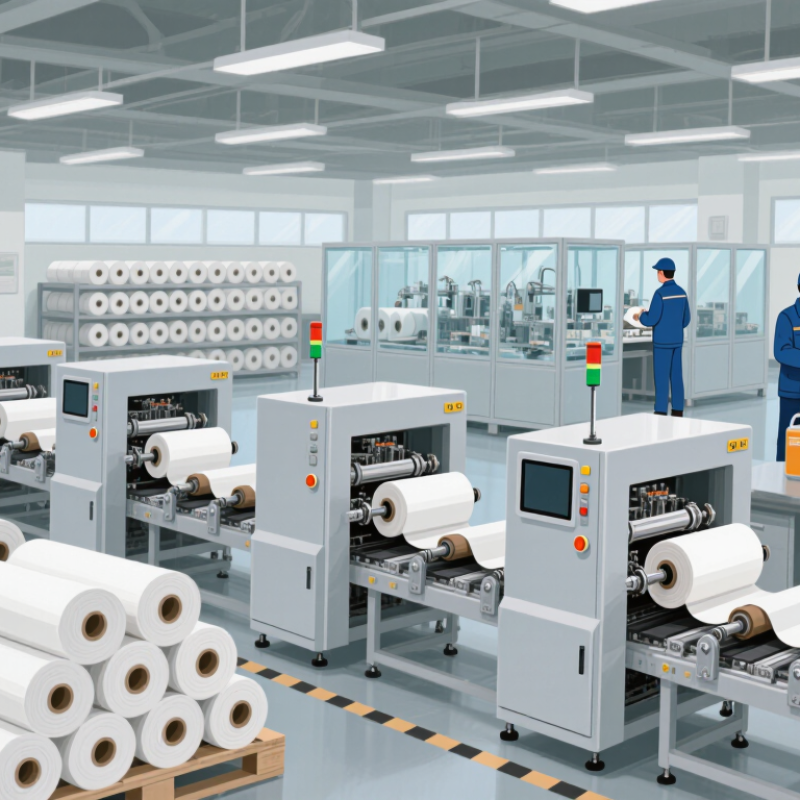
| Material Definition | Thermal bond nonwoven is a web of fibers bonded by heat. The fibers are joined when thermoplastic components soften or melt and then solidify during cooling. | Bonding is achieved without weaving or knitting and generally does not require liquid chemical binders. | Provides a lightweight, clean, and consistently structured material for disposable and durable products. |
| Primary Bonding Methods | Common processes include through-air bonding, hot-air bonding, hot-calender bonding, point bonding, and ultrasonic bonding. | Through-air bonding is commonly used for bulky and soft structures; calender bonding is commonly used for smoother and more compact sheets. | The bonding method affects softness, bulk, strength, air permeability, thermal insulation, and surface appearance. |
| Common Fiber Types | Thermoplastic fibers and bicomponent fibers are widely used. Bicomponent fibers may have a low-melting sheath surrounding a higher-melting core. | Frequently used fiber families include polypropylene, polyester, polyethylene, and polypropylene/polyethylene or polyester/polyethylene bicomponent fibers. | Fiber selection determines heat resistance, recyclability, moisture behavior, softness, and compatibility with the production process. |
| Basis Weight | Basis weight is the mass of nonwoven material per unit area. | Typical commercial range: approximately 15–300 g/m² | Low basis weights suit wipes, filtration, and lightweight hygiene components, while higher basis weights support insulation, furniture, and automotive applications. |
| Thickness | Thickness depends on fiber fineness, web structure, bonding temperature, bonding pressure, and compression. | Typical range: approximately 0.2–10 mm, with bulky through-air bonded grades generally at the higher end. | Thickness influences cushioning, thermal resistance, acoustic absorption, drape, and package volume. |
| Tensile Strength | Tensile strength is the maximum force a sheet can withstand before breaking. It is normally reported in the machine direction and cross direction. | Performance varies significantly by basis weight and construction; higher basis weight and stronger bonding generally increase tensile strength. | Suppliers should provide direction-specific test results because nonwoven properties can be anisotropic. |
| Elongation | Elongation describes the percentage increase in length before rupture. | Thermal-bonded grades may range from relatively low elongation in compact calender-bonded sheets to higher elongation in lofty, flexible structures. | Important for products that must conform to curved surfaces, stretch during converting, or resist tearing during use. |
| Air Permeability | Air permeability measures the volume of air passing through a defined area under a specified pressure difference. | Values depend on basis weight, pore size, fiber diameter, thickness, and bonding pattern. | Critical for filtration media, breathable hygiene products, medical fabrics, insulation, and ventilation-related components. |
| Softness and Hand Feel | Softness is influenced by fiber fineness, bonding density, surface finish, bulk, and the use of bicomponent fibers. | Through-air bonded structures generally offer higher loft and softness than heavily calendered structures with similar basis weight. | Softness is a key purchasing criterion for hygiene, medical, apparel, bedding, and skin-contact applications. |
| Thermal Insulation | Bulk and entrapped air reduce heat transfer through the nonwoven structure. | Higher loft and lower compression typically improve insulation performance, although actual thermal resistance must be measured for each grade. | Relevant to automotive interiors, building materials, protective clothing, sleeping products, and home furnishings. |
| Moisture Behavior | Moisture absorption and liquid transport depend mainly on fiber chemistry, surface treatment, pore structure, and product design. | Polypropylene and polyethylene are generally hydrophobic; polyester is also low-absorbency, while hydrophilic finishes can improve liquid handling. | Suppliers should identify whether the material is hydrophobic, hydrophilic, absorbent, or treated for wicking. |
| Dimensional Stability | Dimensional stability describes resistance to shrinkage, distortion, or permanent deformation during processing and use. | It is affected by fiber type, thermal history, bonding temperature, web tension, and storage conditions. | Stable dimensions are essential for die cutting, lamination, pleating, sewing, and automated assembly. |
| Surface Characteristics | Thermal-bonded nonwovens can be engineered with smooth, embossed, perforated, patterned, lofty, or textured surfaces. | Point-bond patterns may improve sheet integrity, while through-air bonding can create a softer and more three-dimensional surface. | Surface design affects appearance, friction, printability, coating adhesion, and contact comfort. |
| Typical Width Capability | Production lines can manufacture narrow rolls for specialized converting or wide rolls for industrial applications. | Commercial widths commonly range from less than 1 m to more than 5 m, depending on the production line and product specification. | Width capability influences material yield, splice frequency, converting efficiency, and transportation costs. |
| Color and Finishing Options | Products may be supplied in natural white, colored, printed, embossed, laminated, perforated, or surface-treated forms. | Available options depend on fiber compatibility, bonding equipment, finishing lines, and order volume. | Confirm color consistency, treatment durability, roll appearance, and minimum order requirements before approval. |
| Common Applications | Thermal-bonded nonwovens are used in hygiene products, medical disposables, filtration, furniture, bedding, automotive interiors, insulation, agriculture, and packaging. | Different applications require different combinations of softness, strength, loft, permeability, barrier performance, and heat resistance. | A capable supplier should recommend a grade based on the finished product rather than only on basis weight. |
| Quality Control Tests | Typical tests include basis weight, thickness, tensile strength, elongation, tear strength, air permeability, shrinkage, moisture content, and appearance inspection. | Testing methods should be clearly identified, such as ISO, ASTM, EN, or another agreed technical standard. | Comparable test methods make it easier to evaluate samples from different global suppliers. |
| Regulatory and Safety Documentation | Depending on the application, buyers may require technical data sheets, safety documentation, restricted-substance declarations, traceability records, and product compliance statements. | Requirements vary by destination market and end use, particularly for medical, hygiene, food-contact, automotive, and construction products. | Documentation supports import clearance, customer approval, audits, and risk management. |
| Sustainability Considerations | Environmental performance depends on polymer selection, recycled content, product weight, manufacturing energy, durability, and end-of-life options. | Single-polymer constructions can simplify recycling compared with products made from several incompatible polymers, subject to local recycling infrastructure. | Suppliers should provide clear information about recycled content, certifications, energy use, and disposal limitations. |
| Supplier Evaluation Criteria | Important criteria include production capacity, process consistency, sampling speed, technical support, quality systems, traceability, packaging, and export experience. | Request a technical data sheet, certificate of analysis, sample rolls, test reports, and production lead-time information before placing a commercial order. | A structured evaluation reduces variation between batches and helps confirm suitability for high-speed converting. |
| Packaging and Storage | Rolls are commonly protected with moisture-resistant wrapping and core protection. Storage should avoid excessive heat, moisture, sunlight, and contamination. | Recommended storage conditions depend on polymer type and finishing treatment; the supplier should provide product-specific guidance. | Correct storage helps maintain roll shape, color, moisture level, bonding performance, and converting behavior. |